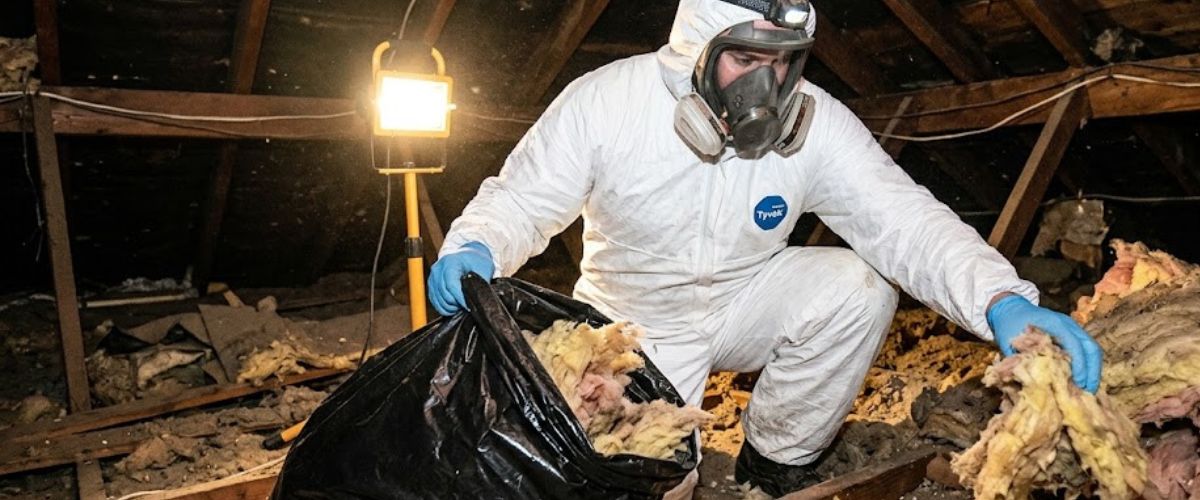
What rodent decontamination addresses, and what it doesn't
Rodent odor removal and decontamination is the cleanup phase that follows successful population control. Trapping and exclusion sealing removes the live animals and prevents re-entry. Decontamination removes what they left behind: urine-saturated insulation, fecal accumulation on joists and rafters, dead carcasses in inaccessible cavities, and the pheromone trails that attract subsequent rodents to the same entry routes.
Decontamination does not address structural damage, gnawed wiring, damaged vapor barriers, or compromised insulation R-value. Those are repair items addressed under our rodent damage repair and attic restoration services. But eliminating the biological contamination is the prerequisite for everything else, you can't accurately assess structural damage through urine-black insulation, and you can't safely work in a contaminated attic without first controlling pathogen exposure.
Sources of rodent odor in Chattanooga homes
- Dead rodents in wall cavities: Rodents that die in sealed wall voids after exclusion work produce odor for weeks to months. Location is usually determined by following the strongest smell, walls near water pipes are common sites because rodents seek moisture before death. Locating and extracting carcasses sometimes requires opening drywall.
- Urine-soaked attic insulation: Roof rat colonies that used attic insulation as both runway and latrine for multiple breeding cycles can saturate cellulose or fiberglass batt insulation beyond cleanup. The insulation must be physically removed. HEPA vacuuming and disinfection alone cannot address fully saturated material.
- Crawl space contamination: Norway rats and house mice in crawl spaces leave fecal accumulation on vapor barriers and floor joists. In Chattanooga's humid climate, this material retains moisture and continues to generate odor and pathogen risk for months after the infestation is resolved.
- HVAC system contamination: Air handlers located in contaminated attics or crawl spaces draw contaminated air through the system. Duct cleaning after attic or crawl space decontamination is often necessary to fully resolve odor in the living space.
- Pheromone residue on entry surfaces: Rodent sebaceous glands leave pheromone-laced grease marks along travel routes that persist after cleaning and attract new animals to the same entry points. Enzymatic cleaners applied to entry surfaces after exclusion sealing interrupt this attractant.
Decontamination process
Dead-carcass sweep
Full attic and crawl space search for deceased animals. Accessible carcasses removed and disposed of. Inaccessible wall-cavity locations identified by odor concentration mapping.
Contamination assessment
Insulation contamination extent mapped. Judgment on cleanup vs. replacement made on-site with client. Written scope provided before work begins.
HEPA vacuuming
Fecal pellets and debris HEPA-vacuumed from rafters, joists, and insulation surfaces. Disposable HEPA filters, contaminated material contained, not redistributed.
Disinfection treatment
EPA-registered disinfectant applied to all contaminated surfaces. Enzymatic odor-neutralizer applied to entry-point surfaces and runway paths.
Insulation removal (if required)
Fully saturated insulation removed via negative-pressure equipment to prevent cross-contamination of living spaces. Bagged and disposed. New insulation quoted separately.
Pricing
| Scope | Typical range | Notes |
|---|---|---|
| Decontamination inspection | Free | Contamination extent mapped, written scope provided. |
| Surface disinfection + HEPA vacuum (intact insulation) | $400–$900 | Attic or crawl space with moderate contamination, insulation intact. |
| Partial insulation removal + disinfection | $700–$1,400 | Heavily contaminated zones removed. Intact areas treated. |
| Full attic insulation removal (1,500–2,500 sq ft) | $1,200–$2,800 | Complete removal. New insulation quoted separately. |
| Crawl space cleanup + vapor barrier treatment | $600–$1,200 | Fecal removal, joist disinfection, vapor barrier assessment. |
Factors that change your specific quote
- Odor source location — carcass-in-wall vs accumulated waste vs urine saturation
- Affected area square footage
- Treatment method — enzyme-based, ozone generation, hydroxyl, or combination
- Number of treatment cycles — single-pass vs multi-day ozone for severe cases
- Material replacement needs — sometimes affected drywall or insulation must be replaced rather than treated
About insurance: Odor removal is generally not covered. If the underlying cause (carcass in wall, water damage from rodent activity) is documented as sudden-and-accidental, related repair work may qualify.
Want your real number? Call (844) 635-0403 for a free on-site free odor assessment.
Common mistakes Chattanooga homeowners make with rodent odor
Rodent odor calls usually arrive after the homeowner has already tried several other solutions, air fresheners, candles, charcoal bags, baking soda. By the time we get the call, the smell has been present for one to three weeks and the urgency level is high. The mistakes that brought the homeowner to that point are predictable.
Confusing odor masking with odor elimination. Plug-in air fresheners, candles, and spray products mask odor for hours while the underlying source continues to release decomposition products. The masking creates a false sense of progress while the actual contamination persists. Eliminating the source, not masking the symptom, is the only approach that produces durable resolution.
Buying ozone generators without understanding their limits. Ozone treatment works on airborne odor molecules but doesn't reach contamination absorbed into insulation, drywall, or wood framing. Homeowners run ozone for a weekend, experience temporary improvement, declare the issue solved, and then face the smell returning within one to three weeks as the absorbed source re-emits. Ozone has a legitimate role as a finishing step after source removal, it doesn't substitute for source removal.
Cutting drywall in random locations hoping to find the carcass. Methodical search, inspection camera through minimal openings, probe to confirm location, controlled access, finds the carcass without major destruction. Exploratory drywall cutting in arbitrary locations leaves the homeowner with significant patching costs and often doesn't find the source anyway. Most carcasses are in insulation pockets rather than wall cavities. The inspection approach matters as much as the willingness to open access.
Waiting two weeks to see if the smell goes away. Smell from a dead rodent in summer Chattanooga conditions intensifies for two to three weeks, plateaus for one to two weeks, and then gradually declines over an additional eight to twelve weeks of absorbed-odor decline. The full natural-decline timeline is roughly 90 to 120 days from death to acceptable odor level. Waiting for natural resolution means living with the smell for that entire period, which is usually unacceptable once homeowners understand the timeline.
We treat the odor without addressing the underlying infestation. A single dead rodent shows a population that was present somewhere on the property. Odor removal without addressing the broader infestation means more dead rodents and more odor events over the following months, particularly if rodenticide was used somewhere on the property and the affected animals are dying gradually in inaccessible locations. The complete job includes inspection of the underlying infestation source, not just removal of the visible odor event.
Frequently asked questions
Why does my home still smell like rodents after treatment?
Persistent odor after treatment almost always traces to a dead rodent in an inaccessible cavity, urine-saturated insulation in the attic or crawl space, or dried fecal matter on structural surfaces. Trapping removes live animals but leaves the contamination, decontamination is a separate step that must follow population control.
How long does dead rodent smell last?
A dead mouse in a wall cavity: 1–4 weeks in warm months. A dead Norway rat: 3–8 weeks. A dead roof rat in a Chattanooga attic (where summer temps exceed 120°F): 2–4 weeks of intense odor before desiccation. Decontamination is the only reliable resolution. Odor-masking products cannot reach the source.
Is rodent urine in my insulation a health hazard?
Yes. Dried rodent urine and feces can harbor hantavirus, leptospirosis organisms, and salmonella. In Chattanooga's humidity, contaminated insulation retains moisture and supports pathogen viability longer than in drier climates. HVAC systems with air handlers in contaminated spaces can circulate contaminated particulates into living areas.
What does rodent decontamination cost in Chattanooga?
Surface disinfection with intact insulation: $400–$900. Full contaminated insulation removal in a 1,500–2,500 sq ft attic: $1,200–$2,800. Exact scope and cost provided after the free inspection.
Will ozone treatment remove rodent odor from my Chattanooga home?
Sometimes, for airborne molecules, not for absorbed contamination. Ozone neutralizes some volatile organic compounds in air but does not reach into insulation, drywall, sub-flooring, or wood framing where rodent urine and decomposition products are physically absorbed. Properties that use ozone-only treatment often report 50–70% odor reduction immediately, with the smell returning within 1–3 weeks as the absorbed source re-emits. Effective decontamination requires removal of the contaminated material (insulation, soft goods) plus enzymatic treatment of remaining surfaces, with ozone as an optional finishing step rather than a primary protocol.
What product do you use for rodent decontamination?
Three product categories in sequence. First: an EPA-registered bactericidal cleaner (usually a quaternary ammonium or hydrogen peroxide formulation) applied to all hard surfaces in the contaminated zone, eliminates bacterial load including Salmonella, Leptospira, and any hantavirus particles. Second: an enzymatic odor neutralizer (usually a protease-based formulation) that breaks down the protein components of urine and decomposition products at the molecular level. Third: an antimicrobial sealant applied to porous surfaces (sub-floor, framing, attic decking) where complete removal isn't possible. Each product has different surface compatibility, dwell time, and ventilation requirements. We use them in the right order for each situation.
How do I know if the rodent smell is actually rodent or something else?
Rodent-source odor has three characteristic signatures. Active urine accumulation: ammonia-forward, sharp, strongest near nesting sites and along established runways, present even when no dead animal is around. Decomposition: putrid sweet-rotten character with cadaverine notes, develops 3–7 days after a death, peaks at 2–3 weeks. Long-term contamination: musty, earthy, sometimes mistaken for mildew or mold, lingers months after population removal. Confounders include: sewer gas (sulfur, distinct from any rodent profile), HVAC mildew (musty but without the cadaverine note), and wildlife-other-than-rodent (raccoons, squirrels, and possums have different decomposition profiles). A 10-minute inspection usually distinguishes them.
Will the smell come back after decontamination?
Not from the treated source if the work was complete. The smell returns when one of three things wasn't addressed: a second contamination site that wasn't found in the original inspection, an ongoing infestation that wasn't resolved before decontamination (new animals create new contamination), or absorbed contamination in materials that weren't accessible during treatment. We do post-decontamination verification at 7 days and 30 days to confirm the work held. Most return-smell calls trace to one of the first two factors, not to incomplete decontamination of the original site.
Is rodent contamination dangerous to my children or pets?
Both can be exposed to risks that adults shouldn't ignore. Children are at higher risk from hantavirus, lymphocytic choriomeningitis virus, and certain bacterial exposures because their hand-to-mouth behavior brings them into contact with surfaces adults wouldn't touch. Pets, particularly dogs that explore yard and crawl space areas, face leptospirosis risk and the secondary-poisoning risk if they consume a contaminated rodent. Active decontamination work has dwell-time and ventilation requirements that we communicate to the homeowner before each visit. Following them keeps the household safe during and after treatment. Persistent contamination without decontamination is the higher long-term risk.