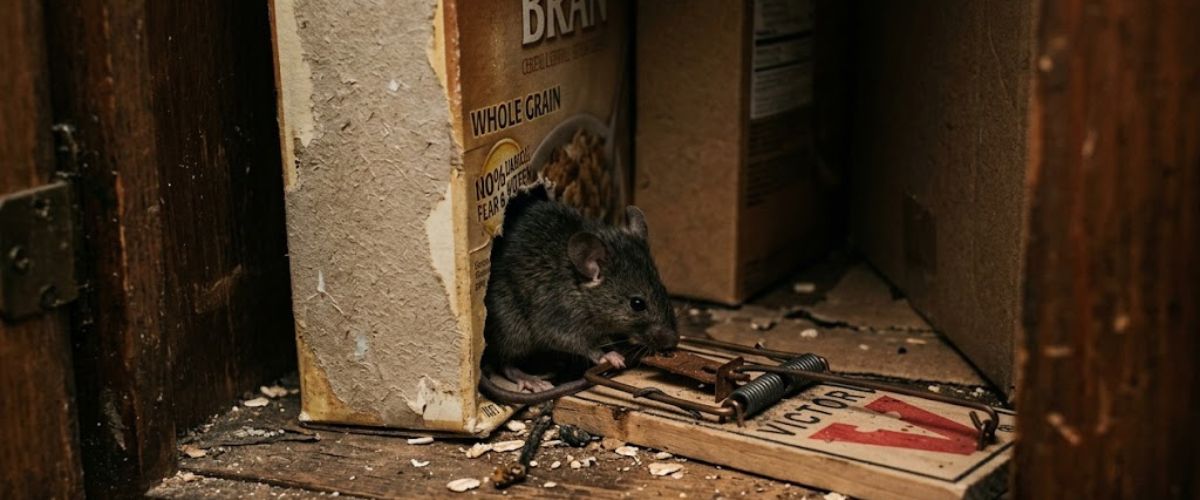
Why professional trapping outperforms DIY in Chattanooga
The trap type and the bait matter far less than where the trap is placed. This is the insight that separates professional trapping from DIY programs that run for weeks with no catches. Rodents are creatures of habit, they travel the same runways repeatedly and approach new objects with significant neophobia (fear of unfamiliar things). A snap trap placed on a runway produces catches within 24–72 hours. The same trap placed one foot off the runway, in an area the rodent doesn't travel, can sit for weeks with nothing.
The runways are different for each Chattanooga species. Roof rats travel along the tops of attic joists, along the wall-plate junction at the top of interior walls, and along the upper surfaces of roof trusses, elevated surfaces in the attic, not the floor. Traps placed on the attic floor catch nothing. Norway rats hug the base of walls at ground level, following the wall junction as a navigation guide. House mice run within 12 inches of a wall and investigate new objects more readily than rats, they're caught faster, but placement still matters.
Professional trapping starts with the inspection that maps the runways, nesting areas, and travel routes, then places traps directly on the confirmed activity zone.
Trap types we use for Chattanooga rodent jobs
Snap traps
The Victor Professional and equivalent commercial snap traps are the most reliable, fast-kill option for rat removal in Chattanooga attics and crawl spaces. Set in pairs on confirmed runways.
Best for: roof rats on attic joists · Norway rats along foundations
Multi-catch stations
Wind-up or mechanical multi-catch stations catch multiple mice without re-setting. Effective in high-density mouse populations in Chattanooga basement and garage situations.
Best for: house mice in garages · commercial kitchens · storage areas
Live-catch cage traps
Wire cage traps for properties where live release is the priority. Checked every 24 hours maximum. Animals released 1–2+ miles from property per Tennessee wildlife guidance.
Best for: humane removal requests · single-animal situations
CO₂ kill traps
Instantaneous CO2-powered kill traps. No bait required, no secondary poisoning risk, no chemical exposure. Higher per-unit cost but zero environmental footprint.
Best for: raptor-adjacent properties · pet-heavy homes · schools
Bait stations (exterior)
Tamper-resistant exterior bait stations for perimeter treatment of commercial properties and high-pressure Norway rat burrow sites. Locked, labeled, service-logged.
Best for: restaurant perimeters · warehouse loading docks · burrow sites
Tracking stations
Non-toxic flour or tracking-powder stations that record rodent footprints without catching or killing. Used to map activity zones before trap deployment and to confirm eradication after.
Best for: population assessment · post-treatment confirmation
Species-specific trap placement in Chattanooga homes
| Species | Where they run | Trap placement | Bait (fall/winter) |
|---|---|---|---|
| Roof rat | Tops of attic joists, wall-plate junction, along rafters and trusses, soffit edges | On top of joist, perpendicular to travel direction, trigger facing the wall. Pairs every 10–15 ft of active runway. | Hazelnut spread or peanut butter (nut-based). Nesting material in spring. |
| Norway rat | Along base of walls, behind appliances, in basement corners, under floor-level equipment | Against the wall with trigger facing outward, in pairs. Behind fixed appliances, in utility corridors, at the base of stairs. | Peanut butter or meat-based bait. Nesting material less effective. |
| House mouse | Within 12 in of walls, behind cabinetry, under appliances, in stored-goods areas | Perpendicular to wall, trigger facing wall. Every 6–8 ft in active areas. More placement points needed, mice have smaller home ranges than rats. | Peanut butter, chocolate-hazelnut spread, or nesting material. Mice are less bait-selective than rats. |
Why bait matters, and the seasonal shift in Chattanooga
Bait selection is secondary to placement, but it matters more than most DIYers expect, and it changes by season in Chattanooga.
- Fall and winter (September–February): Nut-based baits dominate. Roof rats and house mice are transitioning off their summer diet of natural mast crops (pecans, acorns, hickory nuts from the Lookout Mountain and Missionary Ridge canopy). Peanut butter and hazelnut spread are highly attractive because they mimic the nutritional profile of what the rodents were eating before the mast dropped.
- Spring (March–May): Nesting material becomes a strong attractant as breeding season begins. Cotton balls, dental floss, and small fabric scraps placed in or near the trigger outperform food bait on breeding-stage females. This is the season most Chattanooga DIY programs underperform, homeowners keep using fall bait in spring conditions.
- Summer (June–August): Protein-based baits work well for Norway rats in the Southside and downtown restaurant corridors. Roof rat activity slows in July–August and traps need to be left in place longer before catching.
The trapping timeline for a typical Chattanooga home
Most Chattanooga residential trapping programs run 2–4 weeks from first visit to confirmed clearance:
- Day 1. Inspection and trap set: Full attic or crawl walk, runway mapping, initial trap deployment. 6–12 snap traps for a typical attic roof-rat job.
- Day 5–7. First check: Remove catch, re-set, assess. High catch on the first check is a good sign, it confirms the traps are on the runways.
- Day 12–14. Second check: Population decline should be visible. Adjust placement where catches drop to zero.
- Day 19–21. Third check: Zero catch over the last two visits triggers exclusion sealing as the final step.
- Exclusion: All identified entry points sealed. Prevents the next population from entering.
Heavy infestations, large populations, extensive runway networks, or multiple species, can extend to 5–6 weeks and require additional trap density.
Traps not catching anything? Let us reset them correctly.
Placement is everything. Same-day inspection across Hamilton County, open 24/7.
Rodent trapping cost in Chattanooga
| Scope | Typical range | Notes |
|---|---|---|
| Inspection | Free | Species ID, runway mapping, trap placement plan. |
| Trapping only, 2–3 check visits | $280–$450 | No exclusion sealing. Suitable for light infestations or assessment. |
| Trapping + primary exclusion sealing | $450–$900 | Recommended baseline, removal plus permanent prevention. |
| Live-catch program (2–3 week) | $400–$650 | Cage traps, daily checks, release. Exclusion additional. |
| Commercial trapping (monthly) | $150–$350/mo | Snap trap service + exterior bait station maintenance for businesses. |
Factors that change your specific quote
- Trap type — snap traps, electronic traps, or live-catch cages each carry different per-unit and per-visit cost
- Trap count needed — typical residential job uses 8-25 traps depending on activity span
- Visit frequency — daily checks for live-catch, every-2-3-day for snap programs
- Trapping period duration — most programs run 2-4 weeks until catch rate drops to zero
- Disposal and re-baiting — included in per-visit labor
About insurance: Trapping services are not covered by homeowners insurance. We provide written documentation of catch counts and locations for property management records.
Want your real number? Call (844) 635-0403 for a free on-site free trapping consultation.
Common mistakes that ruin DIY rodent trapping in Chattanooga homes
Hardware-store snap traps work, when placed correctly. The trap itself isn't usually the failure point. The placement, baiting, and follow-through are. Six patterns account for most of the failed DIY trapping calls we get asked to take over.
We place traps in open areas. Rats and mice travel along walls and around obstacles, they almost never cross open floor space if they can avoid it. A trap in the middle of a garage floor catches nothing. Traps placed flush against a baseboard, perpendicular to the wall with the trigger end facing the wall surface, catch the same rodents that ignored the open-floor placement.
Putting too little bait on the trigger. A dab the size of a pencil eraser is the right amount. Larger amounts let the rodent feed without triggering the mechanism. Smaller amounts dry out within 24 hours and lose attractant scent. The bait should be wet and aromatic, not dried-out.
We set traps and never checking them. A snap trap with a dead rat on it stops being effective. New rats avoid the area. Traps need to be checked every 24 to 48 hours during active trapping, reset and rebaited as needed. Set-and-forget produces one or two catches and then stops working.
Buying ultrasonic deterrent devices instead of traps. Federal Trade Commission has issued multiple warnings about ultrasonic pest device marketing. Independent testing consistently shows zero meaningful effect on rodent populations. The devices are safe and harmless, which is why the FTC's complaint is about deceptive advertising rather than product safety, but they don't replace traps.
We use too few traps for the size of the problem. A single trap in a kitchen with multiple mice will catch one mouse, deter the rest, and then sit unused while the population continues. Eight to twelve traps in a single-mouse infestation, twenty or more for a serious population, is the right scale. Trap quantity is cheap. Trap quality and placement matter more than buying premium individual units.
Touching the traps with bare hands and depositing scent. Rodents are sensitive to human scent on objects they're considering investigating. Gloves during setup, especially during the first 48 hours, improve catch rate measurably. After the first catches the trap is contaminated with rodent scent anyway and human-scent caution matters less.
Frequently asked questions
Why isn't the trap I set catching anything?
The most common causes: wrong placement (not on the actual runway), wrong bait for the species and season, trap is too clean and the rodent won't approach it yet, or the trap type doesn't match the target species. Roof rats run along attic joists, a snap trap on the attic floor catches nothing. Correct placement doubles catch rates immediately.
What is the best bait for rat traps in Chattanooga?
Bait selection depends on season and species. In fall and winter, nut-based baits (peanut butter, hazelnut spread) outperform everything for both roof rats and house mice. In summer, protein-based baits work better for Norway rats. Nesting material in spring and early summer triggers activity in breeding-stage populations better than food bait.
How many traps do I need for my Chattanooga home?
One snap trap per 10–15 linear feet of confirmed runway, set in pairs. A typical single-family home with an active roof-rat attic infestation needs 6–12 snap traps in the attic alone. Under-trapping is the most common reason DIY programs fail.
How often do you check traps?
Every 5–7 days for snap trap programs. Live-catch traps are checked every 24 hours, animals cannot be left in live-catch traps longer. Each check removes caught animals, re-sets traps, assesses population decline, and adjusts placement if needed.
What does professional rodent trapping cost in Chattanooga?
A trapping-only program for a single-family home runs $280–$450 for the initial set plus 2–3 follow-up checks. Most homeowners add exclusion sealing, the combined program runs $450–$900 for a typical Chattanooga home.
Why do professional traps catch rodents when my store-bought traps don't?
Three reasons account for nearly every case of failed homeowner trapping. Placement: rodents follow established runways, the wall-to-wall paths their fur leaves grease marks along, and a trap placed in the wrong spot will never trigger. Bait: peanut butter is fine but loses scent within 48 hours. We use fresh bait rotated based on what the local population is feeding on, and for established colonies we use trap-conditioning where the trap is left unset for several days to overcome neophobia. Trap quality: $3 hardware-store snap traps misfire often. Commercial-grade Victor M250 or Trapper T-Rex traps have stronger springs and more reliable triggers. Most homeowner trap failure is a placement issue, not a trap-quality issue.
How many traps will you set in my Chattanooga home?
Depends on the infestation extent and structure size. A typical single-rat-in-the-attic situation in a Chattanooga ranch home gets 6–10 snap traps across the attic floor, runway perimeter, and any rafters with visible activity. A mouse infestation in a kitchen and adjacent walls gets 8–15 traps including under-cabinet, behind-appliance, and in-cabinet placements. A Norway rat foundation problem gets 4–6 exterior tamper-resistant trap stations plus 6–10 interior snap traps for any rats already inside. The principle: more traps caught rodents faster, because every trap is a chance for an active rodent to interact with the kill mechanism on a single night.
How often do you check and reset rodent traps?
First week: every 2–3 days because catch rate is highest and bait freshness matters most. Weeks two and three: weekly checks, with traps reset and bait refreshed. Once catch rate drops to zero for two consecutive weekly checks, we run a final two-week monitoring period before declaring the infestation resolved. The schedule is the same for residential and commercial. Some homeowners opt for self-service after the initial setup if they're comfortable checking and resetting, we walk them through the technique and provide replacement bait. For commercial accounts, regulatory documentation usually requires we do all checks ourselves.
Will trapping cause a smell if I miss a dead rodent in a wall?
It can, but the risk is greatly lower than with poison-bait approaches. Poisoned rats often die inside walls because the active ingredient takes 3–7 days to work and the animal seeks shelter. Snap-trapped rats die at the trap location, usually in an attic or basement where you can find and remove them, not behind drywall. The 'rats die in walls' problem is primarily a poison-bait problem. That's a major reason our standard interior treatment is trap-based: predictable carcass location, no secondary poisoning risk, no week-long decomposition smell from inaccessible cavities.