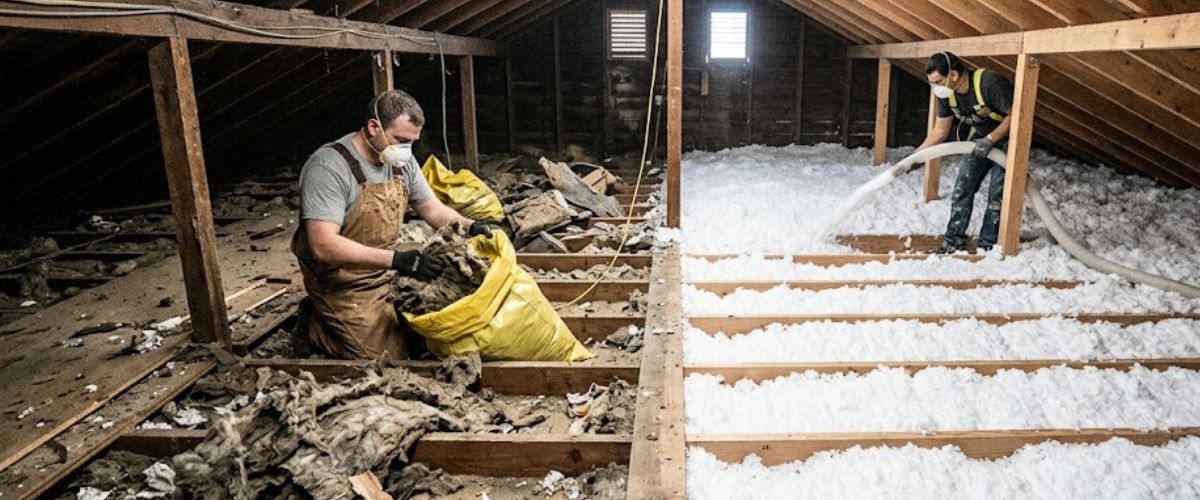
Why full attic restoration is sometimes necessary
Not every Chattanooga attic rodent infestation requires full restoration, but when it does, a partial cleanup is worse than none. Installing new insulation over structural surfaces still saturated with urine and fecal residue traps the contamination beneath a new material layer where it continues to generate odor and pathogen risk while remaining inaccessible for future cleaning. The restoration sequence exists precisely to prevent this outcome.
Roof rat infestations in Chattanooga's heritage neighborhoods, St. Elmo, Highland Park, Missionary Ridge, and Fairmount, most commonly require full restoration when the infestation has run for multiple seasons. A roof rat colony that has been using an attic as both nesting and latrine space for 2–3 years usually contaminates fiberglass batt insulation beyond cleanup. The urine saturation compresses and displaces the batting, reducing its R-value. The fecal loading on the insulation facing and on the rafters below creates a persistent odor source. And the pheromone trails along the insulation surface attract subsequent animals even after the colony is resolved.
The attic restoration sequence
Attic inspection + scope
Free inspection establishing infestation extent, insulation contamination level, wiring condition, and entry point status. Written scope and estimate provided before work begins. Restoration not started until population control is complete and entry points are sealed.
Contaminated insulation removal
All contaminated insulation removed via negative-pressure vacuum equipment that contains debris within the attic and eliminates cross-contamination of living spaces. Material bagged and disposed. Removal is complete, no contaminated material left in place beneath new insulation.
Structural decontamination
All exposed rafter, sheathing, blocking, and structural surface HEPA-vacuumed and treated with EPA-registered disinfectant. Enzymatic odor neutralizer applied to all surfaces. Pheromone trail disruption treatment on entry-adjacent surfaces.
Wiring and structural assessment
All accessible wiring inspected for gnaw damage. Any damage documented and electrician referral made before new insulation is installed. This is the critical gate between decontamination and re-insulation, we don't insulate over uninspected gnawed wiring.
New insulation installation
New blown-in insulation installed to current IECC code R-value (R-49 for Chattanooga Climate Zone 4). Insulation type selected based on attic characteristics. New insulation depth map provided for future reference.
Pricing
| Scope | Typical range | Notes |
|---|---|---|
| Attic inspection + scope | Free | Full walk-through, contamination assessment, written scope and estimate. |
| Partial removal + decontamination | $800–$1,800 | Heavily contaminated zones removed. Intact areas treated. New insulation quoted separately. |
| Full restoration (1,500–2,500 sq ft) | $3,000–$6,500 | Complete removal, decontamination, and new insulation to R-49. All-in. |
| New insulation only (after owner-removed contaminated insulation) | $1,200–$2,500 | Decontamination confirmation inspection required before new insulation is installed. |
Factors that change your specific quote
- Attic square footage and existing insulation depth
- Restoration scope — insulation only, decon + insulation, or full restoration including HVAC duct and electrical re-routing
- Material grade — R-30 standard vs R-49 high-efficiency vs spray foam encapsulation
- Existing damage extent — duct replacement vs duct patching, wiring inspection results
- Sequence — exclusion sealing must complete before restoration begins
About insurance: Full attic restoration sometimes qualifies as a covered claim when combined documentation shows sudden-and-accidental loss. The structured insurance-grade estimate we produce supports the claim.
Want your real number? Call (844) 635-0403 for a free on-site free attic restoration estimate.
Common mistakes Chattanooga homeowners make with attic restoration
Attic restoration is rarely a happy purchase, it's a response to a problem that's already done significant damage. The mistakes homeowners make usually come from trying to minimize the scope, accelerate the timeline, or treat restoration as cosmetic when it's actually structural. Five patterns recur in Chattanooga homes we restore.
Skipping the wiring inspection in older homes. Pre-1990 Chattanooga homes often have aluminum wiring or first-generation Romex with insulation that rodents find palatable. Attic restoration that replaces insulation without inspecting the underlying wiring leaves chewed conductors covered by fresh insulation, with the resulting fire risk hidden until something fails. The cost of a licensed electrician's attic walkthrough as part of restoration is modest compared to the consequences of skipping it.
Reinsulating to the original R-value instead of current code. Many older Chattanooga attics had R-19 or R-30 insulation that was code-compliant when installed but is greatly below current IECC Climate Zone 4 standard (R-49). Restoration is the right time to upgrade, the labor cost is largely already committed and the energy efficiency benefit recovers greatly over the next decade. Reinsulating to the old R-value leaves money on the table.
Failing to address attic ventilation deficiency identified during restoration. Insulation alone doesn't solve attic moisture problems, and many older Chattanooga attics have inadequate soffit-to-ridge ventilation that contributes to the original rodent attraction. Adding ridge venting, gable venting, or additional soffit venting during restoration costs $400-$1,200 and pays back through reduced future rodent pressure and improved energy performance. Skipping ventilation upgrades during restoration is a common regret.
We choose the cheapest insulation type without considering reinsulation risk. Loose-fill cellulose and fiberglass have different characteristics under future rodent activity. Cellulose treats borate fire retardant as a mild rodent deterrent. Fiberglass batting becomes nesting material more readily. For homes in known high-pressure neighborhoods (heritage areas, canopy-adjacent properties), the small premium for cellulose over fiberglass batting is often justified by future-protection considerations.
Returning items to attic storage without verification of clean completion. Homeowners frequently want to return to normal use immediately after restoration, moving holiday decorations, off-season items, and stored materials back into the attic the same week the restoration completes. The 30-day post-restoration verification window (during which we monitor for any sign of recurrence) is the right time to verify the work held before re-introducing storage materials that could harbor future activity.
Frequently asked questions
How do I know if my attic needs full restoration vs, just treatment?
Full restoration is showed when: the infestation ran for more than one breeding cycle. Insulation is visibly saturated with urine (yellow-brown discoloration, ammonia odor). Fecal loading has compressed and displaced batting. Or wiring gnaw damage requires an electrician before re-insulation. Single-season infestations caught early often need only decontamination, not full removal.
What does attic restoration cost in Chattanooga?
Complete restoration for a 1,500–2,500 sq ft home (removal + decontamination + new insulation to R-49): usually $3,000–$6,500. Partial removal + decontamination: $800–$1,800. Written line-item estimate provided after the free attic inspection.
How long does attic restoration take?
A standard restoration for a 1,500–2,500 sq ft home usually takes 1–2 days: removal and decontamination on day one, wiring assessment, and new insulation on day two. Larger or complex attics may take longer.
Will new insulation solve my attic odor problem?
Only if the decontamination phase is thorough before new insulation is installed. Installing new material over contaminated structural surfaces traps the odor beneath it. Our sequence is always: remove → decontaminate → inspect → install. We never compress or skip the decontamination phase.
Will my homeowners insurance cover attic restoration after rodent damage in Chattanooga?
Sometimes, but only under specific conditions. Standard Tennessee homeowners policies usually exclude routine pest damage as gradual maintenance issues. Coverage often does kick in for sudden and accidental damage, most commonly electrical wiring damage that caused a fire or a documented event. We've also seen successful claims where the restoration was bundled into a covered roof or attic event (storm damage with secondary rodent intrusion through the damaged opening). We provide written documentation suitable for adjuster review on every job, photographs of damage, itemized scope, cause-of-loss timeline, so the homeowner can submit a claim if the adjuster determines it qualifies.
Can I stay in my home during attic restoration?
In most cases yes, with some restrictions. Insulation removal phase (Day 1–2) generates significant airborne particulate even with HEPA containment, we recommend the homeowner avoid the home for the hours of active vacuum work, return the same evening. Decontamination phase (Day 2–3) uses EPA-registered antimicrobial product applied via low-pressure spray. The working area is sealed off but the home is occupiable. Reinsulation phase (Day 3–5) is comparable to standard insulation installation in terms of occupiability. The full restoration is usually a 3–5 day project, with 1 day of homeowner displacement at the beginning.
How do you know what insulation R-value to install during restoration?
Chattanooga is in IECC Climate Zone 4, which sets a minimum attic insulation requirement of R-49 for new and renovated structures. Our standard restoration installs R-49 blown-in fiberglass or cellulose to current code, regardless of what was there before. Many older Chattanooga homes had R-19 or R-30 batt insulation that's no longer code-compliant. Restoration is the time to bring the attic to current standard, which also generates utility-bill savings that partly offset the project cost. We document the installed R-value on the project completion report for future appraisal or insurance documentation.
Should I upgrade attic ventilation during restoration?
It's worth assessing. Many Chattanooga attics, particularly in older homes, have insufficient soffit-to-ridge ventilation, which contributes to moisture problems that attract rodents in the first place. If the existing ventilation is inadequate (less than 1 sq ft of net free area per 150 sq ft of attic floor, per Tennessee code) restoration is the right time to add ridge venting, gable venting, or additional soffit venting. We coordinate with a roofing contractor for any ventilation work that requires roof penetration. Most ventilation upgrades add $400–$1,200 to the restoration scope but pay back via reduced rodent pressure and lower utility costs.
What if you find structural damage during attic restoration?
We stop and document. Structural damage, chewed rafter, compromised ridge beam, damaged collar tie, or significant sub-roof rot, is outside our scope and requires a licensed contractor's assessment before restoration continues. The most common findings are not structural but pseudo-structural: chewed electrical wiring (licensed electrician), damaged HVAC ductwork (HVAC contractor), and chewed plumbing or pipe insulation (plumber). We provide written documentation of any finding and coordinate the appropriate trade. Our restoration resumes once their work is complete and inspected.