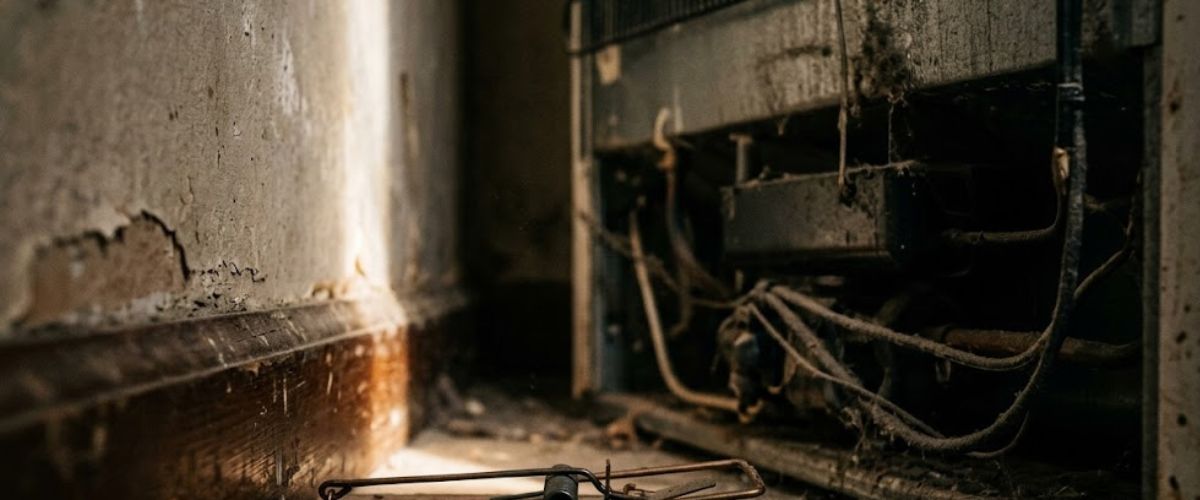
Why the garage is Chattanooga's most common rodent entry point
In our experience across Hamilton County, more than half of residential house mouse infestations enter through the garage first. The reasons are structural and behavioral: garage door bottom seals degrade quickly in Chattanooga's humid climate, side-entry service doors rarely have adequate thresholds, and garages connect to the house through an interior door that is frequently left open and rarely checked for gaps.
The timing follows the seasonal pressure curve. House mice begin moving indoors with the first October cold fronts, and the garage is the warmest, most accessible first stop. A mouse that enters the garage in October will usually move into the living space through the garage-to-house door within 1–3 weeks if that door has any gap at the threshold or frame.
The five garage entry points we find most often
- Garage door bottom seal: Worn or cracked rubber seals, especially at the corners where the seal folds and deteriorates first. A quarter-inch gap at the corner is all a house mouse needs.
- Garage door side gaps: The gap between the door edge and the vertical track. Brush seals on the side track reduce this dramatically. Most Chattanooga garages don't have them.
- Service door threshold: The gap under the side entry door. A standard threshold without a sweep allows mice through freely.
- Utility penetrations: Electrical conduit, water lines, and dryer vents passing through garage walls often have unsealed gaps connecting the garage to the wall cavity and living space.
- Soffit-to-attic connection: In some Chattanooga garage designs, the garage attic connects to the house attic above the interior wall. A mouse in the garage attic can reach the house attic through this connection, we check for it on every garage inspection.
The garage rodent control process
Inspection
Full garage walk-through: droppings mapping, gnaw-mark survey, all five entry-point categories assessed. Interior door gap and threshold checked.
Trap set
Snap traps placed along garage wall junctions, behind stored items, and at the interior door threshold. Bait selected by season and evidence level.
Seal assessment
Bottom seal condition evaluated. Replacement recommended if degraded. Side brush seals assessed and installed if absent.
Structural sealing
Utility penetrations sealed with copper mesh and caulk. Service door threshold and sweep replaced or shimmed. Soffit connection addressed if found.
Follow-up
Return visit in 7–10 days to remove catch, re-set traps, confirm seal integrity, and assess whether activity has moved into the living space.
Pricing
| Service | Typical range | Notes |
|---|---|---|
| Garage inspection + trap set | $175–$325 | 1–2 car garage. First visit including trap placement. |
| Bottom seal replacement | $75–$150 | Standard double-car door. Material and labor. |
| Service door threshold / sweep | $60–$120 | Per door. Material and labor. |
| Full structural sealing | $150–$400 | All identified points: utility penetrations, door seals, soffit connection. |
| Follow-up trap check | $75–$125 | Per visit. Every 7–10 days until activity ceases. |
Factors that change your specific quote
- Garage type — attached, detached, or carport each have different exposure profiles
- Door seal condition — overhead door bottom seal is the most common entry point
- Stored materials — cardboard, fabric, paper storage attracts nesting
- Vehicle wiring exposure — modern soy-based wiring insulation is a known rodent attractant
- Service-bay drains — common entry route in detached garages with floor drains
About insurance: Garage rodent control is not covered. Vehicle wiring damage may be covered under comprehensive auto insurance.
Want your real number? Call (844) 635-0403 for a free on-site garage and vehicle assessment.
Common mistakes with Chattanooga garage rodent control
We replace the garage door bottom seal but not the threshold seal. The horizontal rubber strip at the door bottom is one part of the seal system. The floor-level threshold seal at the concrete is the other. Replacing one without the other leaves a continuing gap. Both components are inexpensive (under $50 combined) and installable in under 2 hours by a homeowner with basic tools.
We use the garage as a staging area for outdoor trash or recycling. Bagged garbage, recycling bins with food residue, and compost staging in garages create concentrated attractant pressure right next to the building envelope. Even short-staging periods (waiting for trash day) sustain populations. Outdoor secure containers with proper distance from the structure eliminate the issue without affecting convenience meaningfully.
Skipping the service door inspection between garage and house. The interior door from garage to house often has incomplete weatherstripping that admits mice from the garage into living space. This is the failure point that produces the "garage to kitchen" migration pattern even after primary garage entry points are sealed. Weatherstripping with full perimeter contact, including a door sweep at the bottom, closes this internal pathway.
Frequently asked questions
Why do mice always seem to get in through the garage?
Bottom seals degrade quickly in Chattanooga's climate, usually 3–5 years before gaps form. Garages are also less maintained, with unsealed utility penetrations and service door gaps that make them the path of least resistance for mice seeking warmth in October.
How do I know if mice are in my garage vs, inside the house?
Garage-specific signs: droppings in corners, gnaw marks on cardboard or pet food, nesting in stored insulation. If droppings appear in kitchen cabinets or under appliances, they've already moved into the living space.
What is a garage door bottom seal?
The rubber strip at the bottom of the garage door. When worn, gaps at the corners allow mice and juvenile Norway rats through freely. Replacement is one of the highest-impact, lowest-cost prevention measures for Chattanooga homes.
Do you seal the garage-to-house door gap?
Yes, we check the interior door threshold, sweep condition, and frame gaps on every inspection. This is as important as the exterior perimeter.
What does garage rodent control cost in Chattanooga?
Inspection plus trap program: $175–$325. Bottom seal replacement: $75–$150 additional. Full structural sealing: $150–$400 additional.
Will rodents damage cars stored in my garage?
Yes, and the damage is among the most expensive rodent damage we see. Rodents chew automotive wiring harnesses (vehicles built since the early 2000s use soy-based wire insulation that rodents find palatable), nest in air filter housings and cabin air filter compartments, and chew through vacuum lines and fuel lines. Repair costs for rodent-damaged vehicles routinely run $1,500–$8,000 and insurance coverage varies. Vehicles stored long-term (winter storage, rarely-driven second vehicles, classic cars) face the highest risk. Garage rodent control protects vehicle inventory as a primary benefit.
What rodent-related items should I remove from my garage?
Three categories drive most attractant problems. Pet food and birdseed in non-sealed containers, every bag of birdseed in a paper bag is a Chattanooga garage rodent feeder. Cardboard boxes used for long-term storage, rodents nest in cardboard, particularly along edges and in seams. Yard waste (raked leaves, mulched grass) stored in plastic bags before disposal, provides immediate nesting material. Replacements: metal trash cans with secure lids for pet food and birdseed, plastic storage totes for box contents, prompt disposal of yard waste rather than garage accumulation. These three changes alone reduce garage rodent attraction greatly.
How do I keep rodents out of my garage during fall in Chattanooga?
Five practical steps homeowners can do themselves. Replace the garage door bottom seal if it's older than 5 years or shows visible wear (the rubber strip at the base of the door, $25–$45 part, 30-minute installation). Seal the gaps at the garage door track sides where the door meets the frame. Inspect the service door (the door from garage to house) for bottom gap and weatherstripping condition. Inspect every utility penetration on garage exterior walls (gas meter, electrical service, hose bibs) and seal with copper mesh and caulk. Check for foundation gaps along the slab-to-wall junction. These five interventions handle 80% of typical garage entry points.
Why do mice always seem to start in the garage and end up in the kitchen?
The shared-wall pathway. Most attached Chattanooga garages share at least one wall with interior conditioned space, often the kitchen, laundry room, or pantry. The wall cavity provides a continuous travel route from garage to interior, and house mice are agile climbers comfortable in vertical wall voids. Once a mouse is in the garage, the path to the kitchen is open through the shared wall. Door-bottom and threshold sealing closes the visible path. Shared-wall sealing (at the top and bottom plates of the wall) closes the hidden path that produces the 'garage to kitchen' migration.