Crawl space rodent pressure in Chattanooga's climate
Chattanooga's humid subtropical climate makes crawl spaces one of the most rodent-attractive spaces in a home. The ridge-and-valley topography creates crawl spaces with variable drainage, some dry, some chronically wet from hillside runoff, and the consistent summer humidity means that even well-drained crawl spaces maintain moisture levels that rodents find attractive without active management.
Norway rats are the primary crawl space rodent in Chattanooga homes at or below grade level, they enter through foundation gaps and establish burrows in the soil beneath the vapor barrier. House mice use the crawl space as a transit zone, entering through foundation vents and moving upward through wall cavities into the living space above. The moisture-rodent connection is direct: wet crawl spaces have more active infestations, more severe infestations, and more rapid vapor barrier damage from rodent activity than dry crawl spaces.
What crawl space rodent prevention covers
- Foundation vent screening: Original foundation vents screened with ½-inch galvanized hardware cloth over the existing vent opening. Mesh sized to prevent Norway rat and house mouse entry while maintaining the airflow the vent was designed for.
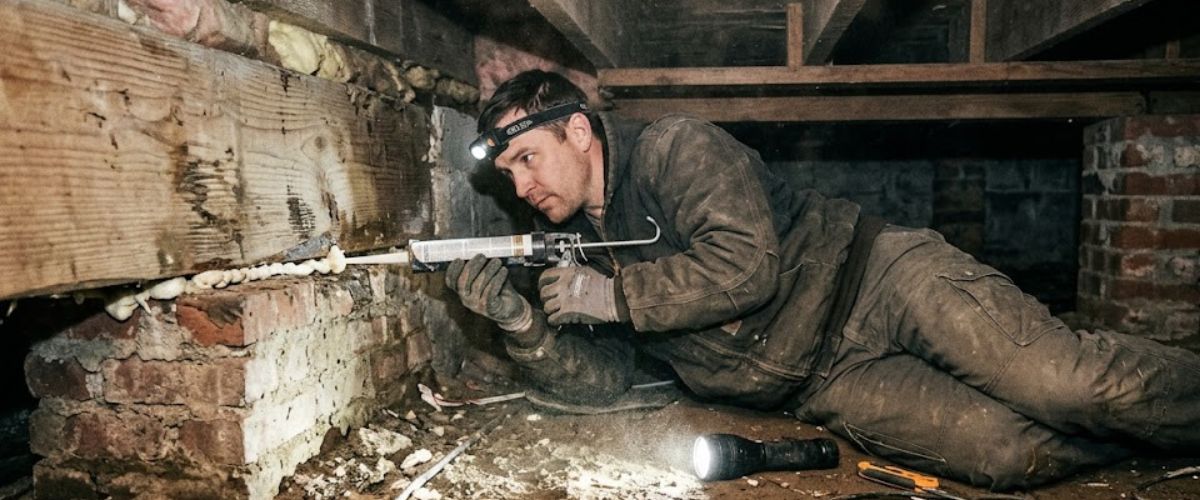
- Foundation wall gap sealing: Cracks, mortar gaps, and weep holes in block, brick, and stone foundations sealed with copper mesh and mortar-compatible products. Poured concrete foundation cracks sealed with hydraulic cement.
- Utility penetration sealing: All utility lines entering through the foundation wall or slab surrounded with copper mesh collars and sealed with appropriate caulk.
- Access hatch sealing: Crawl space access hatch frame gapped sealed. Hatch itself fitted with a compression gasket if absent.
- Vapor barrier assessment: Existing vapor barrier condition mapped, punctures, tears, shredded sections, and areas of inadequate coverage documented. Replacement scope provided if needed.
- Humidity assessment: Ventilation pattern and moisture sources identified. Recommendations for passive ventilation improvement or mechanical dehumidification if humidity is driving the problem rather than entry points alone.
Pricing
| Service | Typical range | Notes |
|---|---|---|
| Crawl space inspection | Free | Entry point mapping, vapor barrier condition, humidity assessment. Written report same-day. |
| Foundation vent screening | $35–$75/vent | Hardware cloth over existing vent. Material and labor. |
| Foundation gap sealing | $150–$450 | Cracks, mortar gaps, and utility penetrations. Based on number and type of entry points. |
| Vapor barrier replacement | $800–$2,200 | Full replacement after decontamination. Based on crawl space size and access. |
Factors that change your specific quote
- Crawl space square footage and clearance height
- Existing moisture conditions — humidity readings above 60% require dehumidification scope
- Vapor barrier condition — 6-mil retrofit vs 12-20 mil encapsulation
- Vent treatment — open vents allow rodent entry; sealing or screening required
- Access door condition — most rodent entry occurs through unsealed access doors
About insurance: Crawl space rodent prevention is not covered. Structural damage from prolonged moisture and rodent activity may qualify under sudden-and-accidental loss if documented properly.
Want your real number? Call (844) 635-0403 for a free on-site free crawl space inspection.
Common mistakes with Chattanooga crawl space moisture and rodents
We install a thin vapor barrier on top of existing rodent contamination. The contamination beneath the new barrier doesn't go away, it becomes inaccessible. Off-gassing continues through any seam or penetration, and the moisture management benefit is partially offset by the trapped contamination. Removal of contaminated material and decontamination should precede any vapor barrier installation.
We close all crawl space vents without adding mechanical ventilation. Closed-crawl design (sealed vents, conditioned crawl space) is effective only with adequate active dehumidification. Closing vents without adding a dedicated dehumidifier or HVAC supply produces a worse moisture environment than leaving them open. Either commit to full encapsulation or maintain ventilated design, partial setups create the worst moisture conditions.
Storing infrequently-used items in the crawl space. Even with a clean vapor barrier and managed humidity, the crawl space remains a difficult environment for stored materials. Cardboard boxes, fabric items, holiday decorations stored in the crawl space accumulate moisture over months, attract rodent nesting if any do enter, and don't actually save space compared to attic or garage storage. The crawl space serves better as a mechanical-systems-only space.
We treat drainage as separate from rodent control. Wet crawl spaces attract rodents through both the moisture itself and the harborage that develops in moisture-friendly conditions. Improving exterior drainage (downspout extensions, grade improvement, gutter maintenance) is rodent prevention even though it's usually framed as moisture management. The two functions are inseparable, addressing one without the other produces incomplete results.
Frequently asked questions
Why does moisture in my crawl space attract rodents?
High humidity (80–90% RH in an unmanaged Chattanooga crawl space) provides comfortable temperature regulation, a ground-moisture water source, and soft wet soil ideal for Norway rat burrowing. Reducing crawl space humidity through vapor barrier management and ventilation is as important as sealing entry points.
What is a vapor barrier and why does it matter?
Polyethylene sheeting on the crawl space floor that limits ground moisture from evaporating into the space. In Chattanooga's climate, homes without intact vapor barriers develop high humidity that accelerates wood rot, supports mold, and creates attractive rodent harborage conditions year-round.
What are the rodent entry points into a Chattanooga crawl space?
Foundation vents with corroded or damaged screens. Foundation wall cracks and mortar gaps (common in pre-1960s brick and stone foundations). Utility penetrations (water lines, drainpipes, HVAC lines). And the crawl space access hatch, which often has no seal between the hatch frame and the foundation opening.
Do I need to treat rodents before installing a new vapor barrier?
Yes, always treat first, then install. Installing a new barrier over an active population traps animals, carcasses, and contamination beneath it. The correct sequence: population control, decontamination, then vapor barrier replacement.
Why are Chattanooga crawl spaces so prone to moisture issues?
Three regional factors converge. Chattanooga's annual rainfall (53+ inches) is among the highest in the Southeast. Soil clay content in the Tennessee Valley holds moisture against foundations rather than draining quickly. Summer dew points consistently above 70°F drive humidity into any below-grade space without active dehumidification. The result: most uncared-for Chattanooga crawl spaces hover at 70–85% relative humidity year-round, well above the 50–55% threshold that discourages rodent nesting and prevents wood rot.
Will encapsulating my crawl space reduce rodent pressure?
Greatly, yes. A fully encapsulated crawl space (sealed vapor barrier on floor, foundation walls, and band joist. Conditioned air or dedicated dehumidifier. Sealed access door) usually reduces relative humidity to 45–55%, which is below the comfort threshold for rodent nesting. Encapsulation also eliminates the harborage opportunities (loose insulation, exposed wood framing) that rodents prefer. Homeowners who encapsulate report 70–90% fewer rodent-related crawl-space issues year over year, plus the energy efficiency benefits of conditioned crawl spaces.
Can you install a vapor barrier without first treating active rodents?
No. Installing vapor barrier over an active infestation traps the rodents underneath, where they continue to damage the new barrier, create new entry points, and require eventual barrier replacement. Our protocol is rodent treatment first (snap-trap removal of the active population, exclusion sealing of identified entry points, verification of zero activity over 2–3 weeks), then vapor barrier installation. Doing them in reverse order doubles the cost and damages the barrier investment.
What kind of rodents are most common in Chattanooga crawl spaces?
Three species, in this rough order of frequency: Norway rats (in suburban and urban properties with adequate foundation gaps or perimeter-grade tunnels), house mice (in nearly any property, they need only a 1/4-inch gap), and occasionally roof rats (in heritage homes where the crawl space connects to canopy-accessible siding via balloon-frame wall cavities). Wildlife (raccoons, opossums, skunks) occasionally enters through larger openings but is treated as a wildlife exclusion job, not rodent control. Identifying the species drives treatment approach. Norway rat protocols don't catch house mice efficiently and vice versa.
How often does a Chattanooga crawl space need rodent service?
After initial exclusion is complete, most crawl spaces need annual inspection rather than ongoing service, entry points stay sealed if the work was thorough, and rodents don't establish in encapsulated or dry crawl spaces without an entry path. Properties with persistent moisture problems, properties adjacent to heavy outdoor pressure (alleys, dumpsters, agricultural land), and properties under active monitoring after a recent issue may need quarterly visits. Homes that have been treated, encapsulated, and inspected annually usually stay clear for 5–10 years between active treatments.