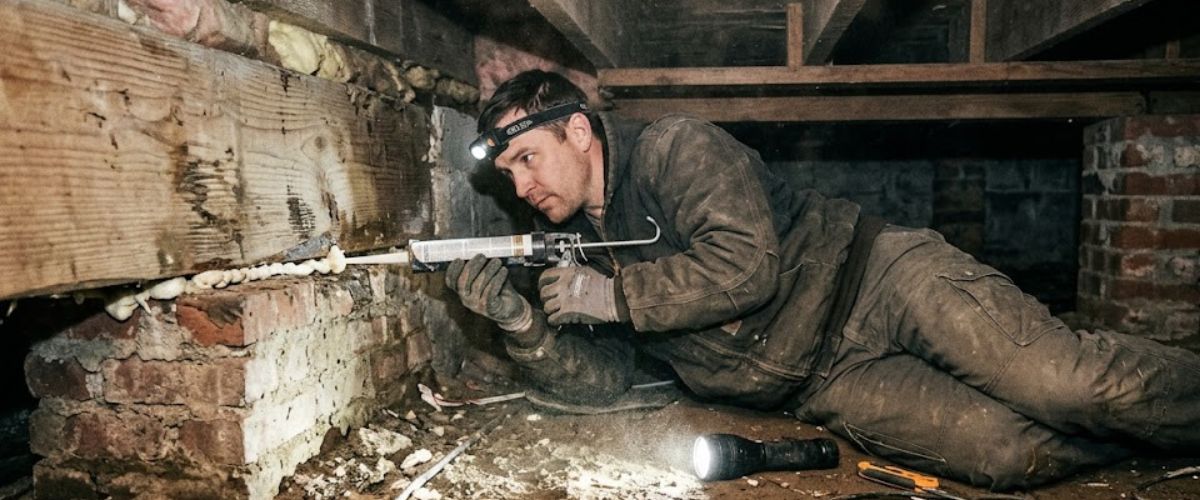
Basement rodent pressure in Chattanooga
Chattanooga basements face rodent pressure from two directions simultaneously. From below, Norway rats burrow under foundation slabs and enter through floor drains, weep holes, and slab penetrations. From above, house mice enter through the foundation sill plate gap and descend into the basement from the wall cavity rather than entering directly from outside at grade.
The Tennessee River corridor intensifies this pressure for downtown and north-side properties. Downtown Chattanooga, Hill City, and Amnicola properties with basements or below-grade utility spaces have measurably higher Norway rat pressure than comparable homes farther from the river. Older homes in Avondale, East Lake, and Orchard Knob have stone or block foundations where mortar joints have cracked over decades, creating Norway rat entry gaps that require mortar-compatible sealing rather than foam.
Common basement entry points in Hamilton County homes
- Foundation wall cracks: Hairline to quarter-inch cracks in poured concrete and block foundations. Norway rats can widen hairline cracks over time. Mice can enter through quarter-inch gaps from the start.
- Foundation sill plate gap: The gap between the top of the foundation wall and the bottom of the first-floor sill plate, a consistent entry point for house mice.
- Floor drains and toilet flanges: Unsealed or screen-free floor drains, particularly in pre-1970s basements where drain caps have corroded or were never rodent-sealed.
- Utility penetrations: Water supply lines, electrical conduit, natural gas lines, and HVAC refrigerant lines passing through the foundation wall or slab without proper sealing.
- Window well drainage: Below-grade window wells without drainage covers allow Norway rats to burrow down and enter through the window sill gap.
- Weep holes in block foundations: Deliberately open weep holes standard in mid-20th century Chattanooga construction are direct Norway rat entry points and should be covered with galvanized mesh rather than sealed solid.
Basement rodent removal process
Inspection
Full basement walk-through: droppings concentration, runways, gnaw damage, and all entry-point categories. Activity level and species confirmed.
Trap set
Snap traps at wall-floor junctions, near drains, behind utility equipment, and at the base of stairs. Norway rat and mouse placement differs by species evidence.
Drain covers
Floor drain covers with rodent screens installed where absent. Weep holes in block foundations covered with galvanized mesh.
Sealing
Foundation cracks sealed with mortar-compatible products for stone/block. Hydraulic cement or epoxy for poured concrete. Utility penetrations sealed with copper mesh and caulk.
Follow-up
Return visits every 7–10 days. Foundation sealing after population is controlled, not before.
Pricing
| Service | Typical range | Notes |
|---|---|---|
| Inspection + trap set | $200–$375 | Single-visit. Snap traps placed throughout basement. |
| Floor drain cover installation | $50–$120 | Per drain. Rodent-rated covers with screen insert. |
| Foundation crack sealing | $150–$400 | Per significant crack zone. Material and labor. |
| Full below-grade exclusion | $300–$700 | All identified entry points sealed after population control. |
Factors that change your specific quote
- Basement type — finished vs unfinished vs partial-finish each have different access
- Entry point sources — exterior cellar door, utility penetrations, sump pump pit, sewer cleanout
- Moisture conditions — basement humidity above 60% creates favorable rodent habitat
- Population establishment — transient activity vs established nesting
- Structural sealing scope — block wall pointing, rim joist sealing, sump pit cover
About insurance: Basement rodent removal is not covered. Water damage from rodent-chewed pipes or sewer-line damage may qualify under separate provisions.
Want your real number? Call (844) 635-0403 for a free on-site basement walkthrough.
Common mistakes during Chattanooga basement rodent removal
Storing cardboard boxes directly on the basement floor. Direct floor contact gives rodents three things at once: insulation from concrete cold, harborage between boxes, and chewable material for nesting. Even a brief storage period, holiday decorations between November and February, becomes attractive harborage. Plastic storage totes on shelving units 6 inches above floor level eliminate the issue.
Running a dehumidifier without addressing the moisture source. Many Chattanooga basements run continuous dehumidifiers to manage clay-soil moisture pressure, but the actual moisture pathway (foundation crack, sill plate gap, exterior grading issue) goes unaddressed. The dehumidifier becomes a permanent expense managing a fixable problem. Addressing the source first, then sizing the dehumidifier for residual humidity, is the more cost-effective sequence.
We seal the basement floor drain without checking for sewer rats. Hard-sealing a floor drain that's now being used as a rodent entry point traps animals inside the lateral, where they die and produce odor problems and potential plumbing issues. Inspection of the drain line (sewer camera) confirms current use status before sealing. Rodent-resistant drain covers that allow drainage but exclude animals are the appropriate replacement.
We treat the basement without inspecting the band joist. The transition between the foundation top and the floor framing, the band joist, is one of the most common rodent entry routes in basements, particularly in pre-1990 homes. Treatment focused on the floor and lower walls misses the band joist consistently. Full basement work includes inspection and sealing of the entire band joist perimeter.
Frequently asked questions
What kind of rodents get into Chattanooga basements?
Norway rats (below-grade burrowers, floor drain entry) and house mice (sill plate gap, utility penetrations). Roof rats are almost never in basements, ceiling-level activity means they entered higher up.
Can rats come up through my floor drain?
Yes. Norway rats can navigate sewer lines. Entry through unsealed floor drains has been documented in Chattanooga properties near the river and in older buildings. Floor drain covers with rodent screens are the effective fix.
How do I tell rats from mice in my basement?
Norway rat droppings: ~20mm, blunt ends. Mouse droppings: 3–6mm, pointed ends. Norway rats leave heavy floor-level gnaw damage. Mice leave smaller marks. Burrow holes 2–3 inches = Norway rats. Quarter-to-half-inch holes = mice.
What does basement rodent removal cost in Chattanooga?
Inspection and trap set: $200–$375. Follow-up visits: $75–$125 each. Foundation sealing and drain covers: $150–$450 depending on the entry points found.
What signs show Norway rats are actively living in my Chattanooga basement?
Five reliable indicators. Fresh smear marks along baseboards and concrete walls (rats follow consistent paths and leave grease tracks). Tunneled-out insulation against foundation walls (nesting material). Droppings concentrated in linear patterns rather than scattered (active runway). Visible burrow entrances in dirt-floor sections or against the foundation exterior visible through basement windows. Audible activity at night (Norway rats are mostly nocturnal). Two or more of these signals together usually means an established colony, not a one-time visitor.
Can rodents come up through the basement floor drain?
Yes, particularly in older Downtown and Southside Chattanooga properties with original cast-iron plumbing. Norway rats can swim and climb through P-traps in low-water conditions. The risk is highest in (a) homes with rarely-used floor drains where the trap has dried out, and (b) properties on combined sewer lines that connect to the older portions of Chattanooga's downtown drainage system. Installation of a rodent-resistant floor drain cover (a $25–$60 part) is the standard fix and we install them as part of any basement treatment in at-risk neighborhoods.
Will basement rodent removal damage my finished basement walls?
Not under our standard protocol. Trap placement uses non-invasive positioning behind furniture, in mechanical rooms, and along wall-floor junctions in storage areas. Entry-point identification uses thermal imaging and acoustic listening to find activity inside walls without cutting drywall. If targeted access is required (locating a dead rodent in a wall cavity, sealing an internal pipe penetration), we open a minimum-size access in an inconspicuous location and patch it back. Most basement jobs require zero drywall work. The few that do require it generate access patches in mechanical rooms or behind built-ins where the patch is never seen.
Why are unfinished Chattanooga basements more rodent-prone than finished ones?
Three reasons. Visible foundation and sill plate, unfinished basements expose every gap and crack in the foundation, which means more identifiable entry points to seal but also more access while they remain open. Exposed utility penetrations, water lines, sewer lines, electrical conduit, HVAC ducts all enter through the basement and unfinished basements show every one without drywall covering them. Storage harborage, unfinished basements usually store boxes, holiday items, and infrequently-used materials that provide nesting opportunities. Finished basements have all the same entry points but the harborage opportunities are minimized and surfaces are easier to maintain pest-free.
How long after basement rodent removal can I store items down there again?
Storage can resume immediately after the active rodent removal phase confirms zero activity (usually 2–3 weeks of trapping with no new catches). Sanitation and decontamination of the previously-affected zones happens before storage resumes, surface treatment of any concrete or masonry the rodents used as runway, application of enzymatic neutralizer to break down urine residue, and HEPA vacuum of any dust accumulation. The 'when can I put my stuff back' question almost always has a faster answer than homeowners expect: usually under 4 weeks total from first visit to safe-storage clearance.