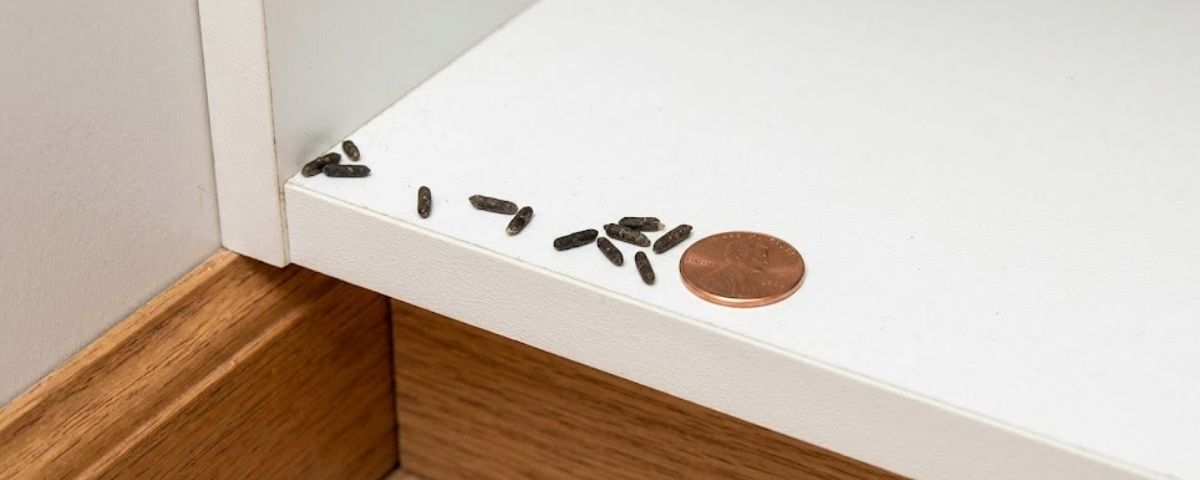
The four signs of house mouse activity
Before any treatment, confirm you have house mice. Several animals produce evidence that homeowners initially mistake for mice: cockroach droppings, lizard droppings, bat droppings (guano), and the shed skins of carpet beetles can all be confused with mouse droppings at a glance. Confirming the species matters because the treatment approaches differ greatly.
Sign 1: Droppings. House mouse droppings are 3–6mm long, roughly the size and shape of a grain of rice, with pointed ends and a dark brown to black color. They're found along runways: the paths mice travel repeatedly between nesting areas and food sources. Common locations: along the back of kitchen cabinet interiors, under the refrigerator, along baseboards in pantries, and in the corner areas of garages. Fresh droppings are dark and somewhat moist-looking. Old droppings are lighter, dull, and crumble when disturbed. If the droppings look like rice grains, you have mice. If they're larger (olive-pit-sized with blunt ends), you have rats, exactly Norway rats.
Sign 2: Sounds. House mice are most active between midnight and 4 a.m., the quiet hours when the house is still. The sounds they produce are light: scratching, gnawing, and rapid scurrying movement, usually inside walls adjacent to kitchen areas, under appliances, and in attic or crawl space access areas. The scratching is more delicate than rat activity. Mice weigh 0.5–1 ounce and produce correspondingly light sounds. If the nighttime noise is heavier, thumping movement, louder scratching, it may be rats or squirrels rather than mice.
Sign 3: Runway marks. Mice travel the same paths repeatedly and leave grease marks from their fur along these routes. Runway marks appear as faint dark smears along walls at floor level, along pipe and conduit runs, and on ledges and beams where mice travel repeatedly. In dusty areas (attic joist runs, crawl space beams), mouse runways are visible as clean tracks in the dust, dust disturbed by repeated passage and left smooth in the center of the travel path.
Sign 4: Gnaw marks. House mice gnaw to access food sources and to wear down their continually growing incisors. Gnaw marks on food packaging in pantries, clean-edged small holes in boxes, bags, or containers, are a direct indicator of mouse activity. Gnaw marks are also found on structural wood at floor level and on the corners of wooden cabinet interiors. House mouse gnaw marks are small (under ½ inch in diameter). Rat gnaw marks are larger and show heavier wood removal.
Confirming house mice vs, other species
House mice vs. rats: Dropping size is the most reliable field distinction. Rice-grain-sized pointed-end droppings = mice. Olive-pit-sized blunt-end droppings = Norway rats. Spindle-shaped pointed-end larger droppings in elevated locations = roof rats.
House mice vs. bats: Bat guano is found in concentrated accumulations directly below roosting sites, is crumbly (contains insect exoskeleton fragments), and has a distinct musty odor. Mouse droppings are distributed along runways, are smooth in texture, and don't accumulate in neat piles under specific overhead points.
House mice vs. cockroaches: Cockroach droppings are either tiny (German cockroach, like ground pepper) or ridge-marked cylinders (large species like American cockroach). Neither matches the smooth rice-grain shape of mouse droppings.
What to do after confirming house mice
Once you've confirmed house mice, the two-step response: snap trap placement where droppings are concentrated, and entry-point detection and sealing to prevent re-entry and block additional mice now outside from entering.
Snap traps: place perpendicular to the wall with the trigger facing the wall surface, in the areas where droppings are concentrated. Peanut butter or a small piece of chocolate is reliable bait. Check daily for the first week, then every 2–3 days. A single mouse is usually caught within 24–72 hours of correct trap placement.
Entry-point sealing: the garage door bottom seal, utility penetrations, and the foundation sill plate gap are the most likely entries. See our entry point sealing guide for the materials and methods that work. If you'd prefer a professional assessment, our entry point detection service is free and identifies every gap before sealing begins.
What to do right now if you think you have mice
Confirm the species before choosing treatment. House mice, deer mice, and young rats can all look similar at first glance, but they require different treatment approaches. Key identification points: house mice are smaller (usually 2.5-3.5 inches body length, tail roughly equal to body), gray-brown coloring throughout. Deer mice are similar size but have white bellies and white feet. Young rats are larger (4+ inches body length), more robust build, thicker tail.
Check for droppings and identify the pattern. Mouse droppings are 3-6mm long, rod-shaped, pointed at both ends. Concentrated in linear patterns (along runways) rather than scattered randomly. Fresh droppings are dark and pliable. Old droppings are gray and brittle. Quantity matters, a few droppings means recent activity, dozens means established population.
Listen at night. House mice are usually nocturnal in heated buildings during winter. Activity sounds: light scratching in walls or ceilings, scurrying across attic decking, brief running sounds at intervals. Sustained activity audible from living spaces shows established population, not occasional visitors.
Look for grease marks. Mice follow consistent paths and deposit oily residue from fur on contacted surfaces. Marks appear along baseboards, around utility penetrations, on edges of openings into wall cavities. Visible grease marks show established travel patterns, not just one-time visits.
Set traps within 24-48 hours of confirmation. Mouse populations grow rapidly, a single pregnant female plus offspring can produce 30+ mice within 90 days. Time-to-treatment correlates directly with eventual cost: addressing a 2-mouse situation costs a fraction of addressing a 20-mouse situation 3 months later.
If you find dead mice but didn't set anything that killed them: Outdoor rodenticide consumption produced the deaths. The carcasses will produce odor problems for 1-3 weeks. Removal is the appropriate response. Protecting any pets from carcass contact is the priority during the removal process.
Same-day rodent control across Hamilton County
Call now — We’ll schedule the inspection while you’re on the phone.