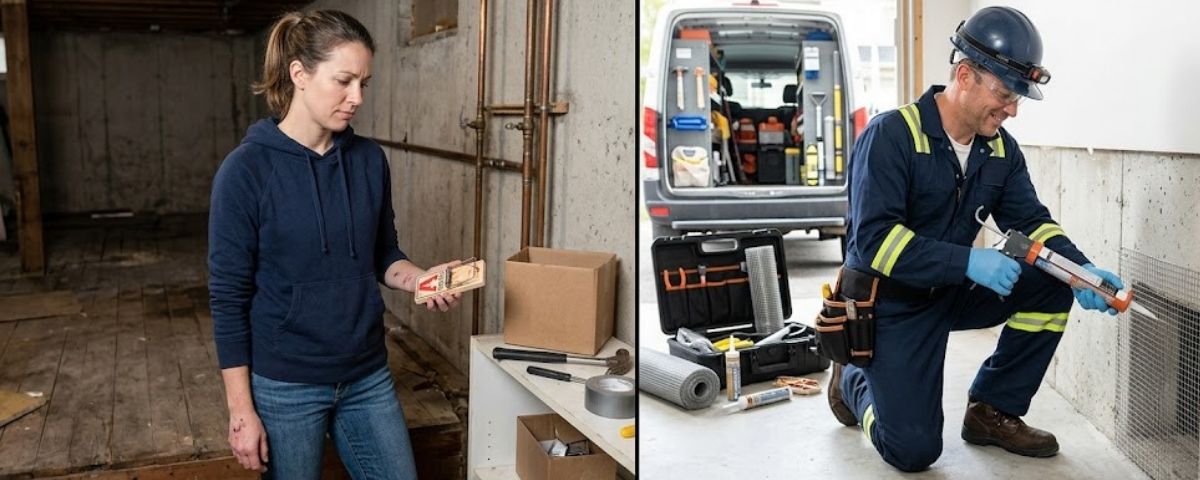
The honest case for DIY rodent control
DIY rat and mouse removal works in a specific set of circumstances, and it's worth being honest about when it does. A single house mouse infestation in a modern, well-constructed home, where the homeowner can identify the entry point, seal it correctly, and place snap traps in the right locations, can be resolved completely without professional help. The materials cost under $30. The technique is learnable in an afternoon. The results, when done correctly, are as durable as professional treatment.
The conditions that make DIY a reasonable choice:
- Single species, light infestation (droppings in one area, no evidence of multiple nesting sites)
- Accessible entry points at ground level in modern construction, garage door seal, accessible utility penetrations
- Homeowner is comfortable in the garage, under sinks, and in easily accessible crawl space or attic areas
- No evidence of wiring gnaw damage (this requires professional assessment)
- No pets with significant yard access that creates bait-station risk
For house mouse control exactly, a $7 snap trap, correctly placed at the right angle to the wall in the area with the highest dropping concentration, often catches the animal within 24 hours. This is not a situation that requires professional intervention.
When professional treatment produces better results
The situations where professional treatment is clearly the better choice:
Multi-species or multi-location infestations. If droppings are in the kitchen, in the garage, in the attic, and in the crawl space simultaneously, you're dealing with either a large infestation or multiple species. Identifying the full extent, correct species identification, and appropriate trap placement across all activity zones is greatly more accurate with a professional inspection.
Roof rat attic infestations. Attic trap placement requires walking the attic safely, identifying runway locations (grease marks on rafters, dropping concentrations), and placing traps in the right spots relative to the rat's travel patterns. Entry-point detection requires inspecting the roofline from inside the attic with a strong light, a technique that produces more complete results than ground-level visual inspection. This is the situation where professional inspection consistently outperforms homeowner self-assessment.
Heritage homes with complex entry points. A pre-1940 home in St. Elmo or Highland Park with original wood soffits, stone or brick foundations, and balloon-frame construction has entry-point complexity that requires experience to assess completely. Missing entry points in heritage construction allows re-infestation as quickly as the homeowner clears the current population.
Norway rat infestations with sewer-source potential. If you're near the Tennessee River corridor, have a basement with floor drains, and the droppings suggest Norway rats, a professional assessment that checks for sewer-source entry, something a homeowner can't easily assess without specialized knowledge, is worth the inspection visit.
Infestation recurrence. If you've self-treated a rodent problem and it's back within a season, the entry points weren't fully sealed. A professional entry-point detection survey finds what the homeowner missed.
The cost comparison that's often misunderstood
The comparison people make is: professional treatment costs $300–$600 vs. DIY at $20–$50. That comparison is accurate for a single visit at a moment in time. The better comparison accounts for outcomes:
A professional treatment that includes entry-point detection, sealing of all identified gaps, and follow-up verification costs more upfront, but produces a sealed building that doesn't re-infest, eliminating future treatment costs. A DIY treatment that misses entry points, or that catches the current mice but doesn't seal the points they used, produces a recurring annual cost of repeated DIY tries that quickly exceeds the professional treatment cost.
For a simple single-mouse house situation in a modern home with one obvious entry point, DIY is genuinely the cost-effective choice. For anything more complex, attic rats, heritage homes, recurring problems, multi-species infestations, the professional treatment that resolves it completely and durably is cheaper over 3–5 years than the recurring DIY cycle.
If you're unsure which situation you have, our free inspection tells you honestly. We assess the extent of the problem and the complexity of the entry points, and if it's a situation where DIY is genuinely appropriate, we'll say so.
What to do right now: a decision framework
Try DIY first if all of these are true:
- Activity is limited to one area (kitchen, garage, basement) and confined to mice or signs of a single rat
- You can identify the obvious entry point (a clear gap somewhere)
- The structure is relatively new (post-1990 construction with intact envelope)
- You're willing to check traps daily for 2-3 weeks
- No food-service operation, healthcare facility, or rental property is involved
- Wiring damage and structural concerns are not visible
For this profile: 8-12 snap traps placed along walls (flush against baseboards, perpendicular to wall), peanut butter or chocolate spread on triggers, daily check and rebait, seal the identified entry point after trapping confirms zero activity for 7-10 consecutive days. Total cost usually under $75 in materials and 30-45 minutes per week in active management.
Call professional service if any of these apply:
- You've seen rats (not just mice), rat infestations rarely resolve with DIY treatment
- Activity is in attic, in walls, or audible across multiple rooms
- You can't identify entry points clearly, the inventory is more than 2-3 visible gaps
- Construction is pre-1990 with heritage features (soffit gaps, original gable vents, masonry chimney issues)
- You've tried DIY trapping for 3+ weeks without resolution
- Wiring damage, structural damage, or extensive contamination is visible
- Food service, healthcare, daycare, or rental property is involved (documentation requirements)
- You're working under transaction time pressure (sale closing, lease starting)
For this profile: DIY is unlikely to produce timely or complete results regardless of effort. The complexity exceeds what consumer products and homeowner labor can address efficiently.
The middle ground: Hybrid approach where homeowner handles consistent attractant management and basic monitoring, professional service handles the technical exclusion work and any complex treatment. This is often the best long-term arrangement once the initial infestation is resolved.
Same-day rodent control across Hamilton County
Call now — We’ll schedule the inspection while you’re on the phone.